
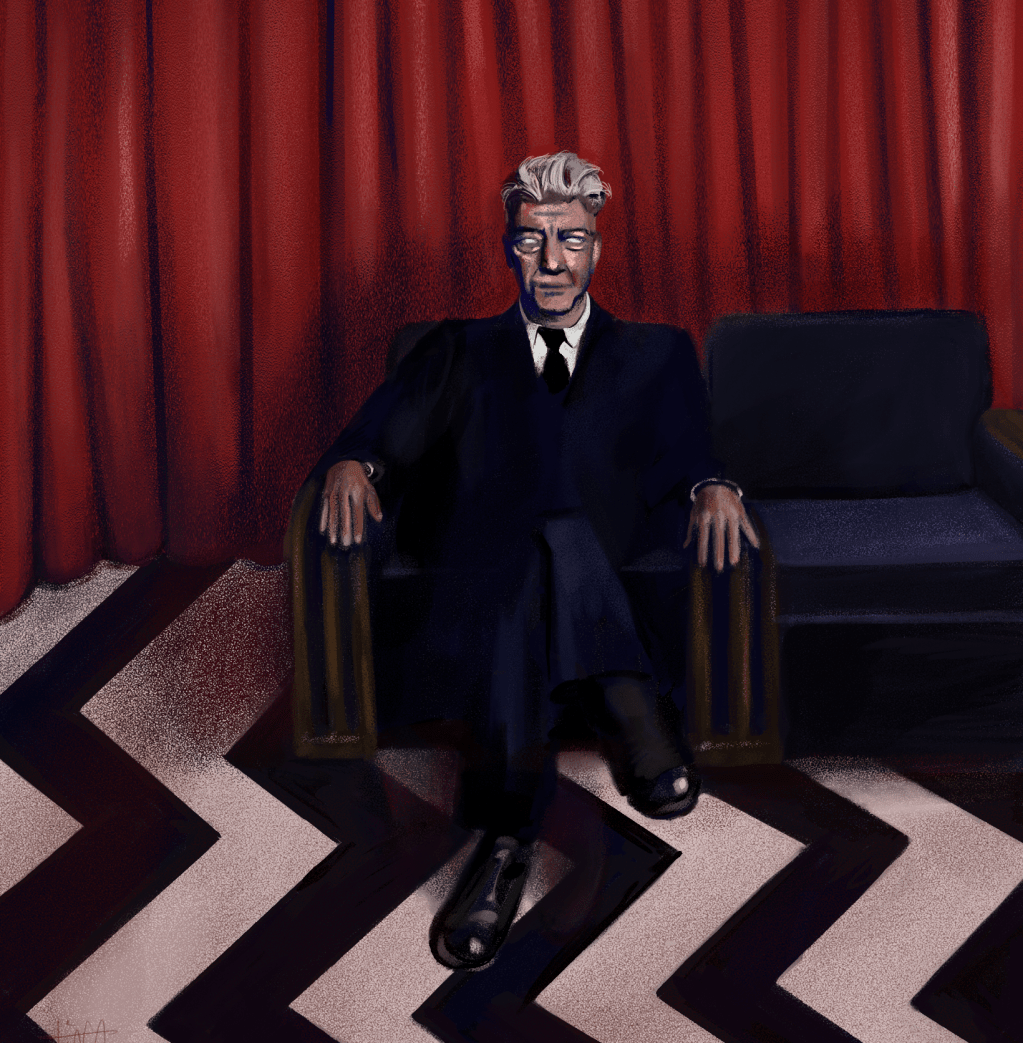
Featured image by ttiinto
David Lynch: Believe it or not, Eraserhead is my most spiritual film.
Interviewer: Elaborate on that.
David Lynch: No.
I’ve been thinking a lot about Lynch since his passing. This famous meme of him refusing to elaborate popped into my Reddit feed, and instead of chuckling and scrolling away, I realized something.
Artists are often expected to explain our work – its meaning, its point, its contents – at the drop of a hat. I can’t count how many times I’ve been asked what my book is about in casual conversation, and the question never ceases to send me into a panic. My words evaporate into thin air, and when I force them out, they come out backwards, as if I’m Laura in the Red Room: !tnatropmi gnihtemos tuoba s’ti raews I
So when David Lynch said no to that interviewer, he paved the way for the rest of us to say no. Saying “no” or even “I can’t explain it” may sound rude, but it’s actually allowing us to keep our work in its purest form, free from labels. We don’t need to put the meaning of our work into words, because we already know it on a subconscious level. We feel it deeply. And if we do our job well, our audience will feel it deeply too.
David often talked about “catching ideas”. He would sit at Bob’s Big Boy diner every day and order a chocolate malt. Then he’d enter a state where ideas are floating like fish in the sea, and he’d wait for one to nibble the hook. If he caught something, he’d jot down the impression of it on a napkin – just a kernel, a spark.

He would then honor the enigma of that idea without attempting to explain it, not even to himself. He’d just admire its beauty. He’d “fall in love with it” and let it blossom however it wanted to.
Between the years 2007 and 2009, Lynch gave talks in 16 countries about Transcendental Meditation. (He practiced the methods Maharishi developed in the 1950s.) During one of these talks in Tel Aviv, an audience member asked David to explain the presentation of women and motherhood in his films. He immediately replied, “No.” Laughter rippled through the audience, but he continued, very seriously, “I don’t think about women and motherhood. I get these ideas, and maybe later I say ‘oohh, there’s a woman here, and this woman is a mother’. The idea comes first. I don’t set out on a theme, I don’t set out to show something; I’m as surprised as anybody when the idea pops in.”
The way David described Transcendental Meditation, or TM, gives some insight into his creative process. You first have to look at the parallels between modern physics and the mysteries of consciousness. In the world of physics, a theory exists about something called the “Unified Field”, a place smaller and deeper than anything we can currently observe.
The theory postulates that all fields we know of (the electromagnetic field, the Higgs field, etc.) are born from a single unified field of potentiality. If you could observe the universe at its most divisible level, you might see a thrumming unified ocean where nothing and everything exists all at once — Schrodinger’s field. But since scientists as of yet have no methods of observing this field, it’s up to us to meditate our way there.
In TM, you adopt a certain mantra that helps you delve deep into your subconscious mind. You start in a place of pure matter — the observable world — and start to go deeper, like a scientist observing the atom, then electrons and protons, then neutrinos, then quarks, and so on. You dive so deep that you reach the Unified Field, the Oneness, God, the Brahman, Allah, the waters of the Nun, the Unending Sea.

David described it as “pure bliss”. It’s a place where everything negative falls away and all that’s left is happiness and peace. The quip “ignorance is bliss” holds true here, because in the Oneness there is no-thing. No opinions, no dogmas, no prejudices, no theories — nothing to “get hung up about”. Just pure energy and the joy of limitlessness.
For me, watching a David Lynch production feels like scientific discovery and Transcendental Meditation all at once. You see “a woman who is a mother” sobbing after finding out her daughter’s been murdered — you observe the atom. Then you dive deeper and deeper. The seemingly happy home turns out to be a cesspool of pain and sorrow and evil — you see the electrons and protons. Then you realize the whole damn town is not as it seems, but there’s hope, good, and redemption amidst the chaos — you see neutrinos and quarks. And in the end, you realize that what Twin Peaks made you feel is everything a conscious being is capable of feeling. You experienced the Unified Field.
But what does it mean? What exactly did Lynch want us to feel or think? Why was there a white horse in the Palmers’ living room, why did Phillip Jeffries blip out of existence, and why the hell did Josie end up trapped inside drawer knob?
I truly don’t believe there’s an all-encompassing meaning. Lynch might have been spiritual and esoterically well-read, but I don’t think he was trying to leave behind a maze of clues leading to hidden knowledge. Lynch was very open about what he believed and actively taught others how to reach spiritual bliss. I think that the mysteries of his work are, at the core, just the archetypes of existence: love, pain, sorrow, fear, evil, and good. Anything more detailed is just the viewer putting their own spin on it.
Not many people know that David originally wanted to be a painter. He had a highly visual mind and often drew random images on the insides of cigarette cartons. I think his artistry heavily influenced what he decided to put in film. For instance, the white horse standing in the Red Room, just in front of the curtain, is an image many would want to frame or have tattooed. It makes us feel or think different things. For some, a white horse symbolizes purity, and for others, horses are a symbol of doom (i.e. the four horsemen of the Apocalypse).
When David was in London talking about TM, an audience member asked him to describe his creative process. This time, David didn’t just say “no.” He explained that our desire for ideas was like putting bait on a hook. You have to have patience, just like you do in fishing. If you let your hook do what it wants on the sea waves, dragging this way and that, you’ll eventually feel a tug on the line. And when you look at what you’ve caught, you see “a little purple fish with red fins and little dancing, speckled eyes.”
If that little purple fish struck a chord in him — if it was an idea “he fell in love with” — he would just go with it. He wouldn’t ask why this fish? He’d go back to Bob’s Big Boy and let that fish marinate in a basket. Then he’d put the hook back into the water and catch more fish. When he had a basketful of fish, he’d have what he called “fragments”. He could see how these fish would come together as a script. And then he’d start writing.
What David Lynch definitely did not do was go into a project with a specific theme or plan in mind. He let the ideas come to him, not the other way around. Maybe he had a dream one night about a white horse and loved it so much he had to put it in Twin Peaks. Maybe Mark Frost’s interest in Kabbalah inspired him to imagine what one of the Sephiroth on the Tree of Life might look like visually. In this way he was like a creative medium. He was so open to whatever came through, especially when he was meditating, that the most inexplicable ideas, and images, emerged. Ideas that many of us would have trouble conceiving ourselves. It’s why we like we have to dissect the meaning of everything in Lynch’s works in order to understand them.
The truth of the matter is, we can’t understand. Not the way Lynch did. The ideas that Lynch caught are the product of his own visitation with the Unified Field. They at once fascinate and confuse us. It’s like asking why someone’s favorite color is green or why they hate the consistency of mushrooms. They just can’t explain it.
Thank you, David, for sharing your ideas with the world. You will be missed, but will always continue to inspire. ❤

Featured Image Credit: ttiinto
ttiinto is a digital artist currently taking commissions. Follow them here!
 Mar von Zellen
Leave a comment