
The two writers
Writers can be boiled down into two types: the write now, edit later type, and the edit-as-you-go type. There are pros and cons of each. If you pour your heart out in one fell swoop, you finish your book fast, but creating a second draft can be a real pain. You might reread certain sections and think “what the hell was I trying to say here?” and never find the answer. On the other hand, if your mind is always split between the writer and the editor, progress on your novel can take forever. The first draft is an unending, Mines-of-Moria level journey.
I’m the edit-as-you-go type. I can’t read a book for fun because of it. I read like an editor just as much as I write like one. My writer-self sits on one shoulder as the inspired angel, while my seething editor-self crouches Gollum-style on the other, ready to hit backspace before I’ve even begun typing. (I’ve already rewritten this paragraph 3 times, ugh.)
The upside to this dual arrangement is that when my first draft is eventually done, I’m pretty happy with it. It already reads with a certain amount of fluidity, like the waters of Anduin. Revision is minimal. Proofreading is easy. There’s no threat of entire chapters needing to be changed or, worse, discarded. But I constantly ask myself if having such a picture-perfect first draft is really worth the struggle.
Writer’s block is my Enemy. There’s always an over-abundance of fear and criticism. By the end of 2021, I had reached a point where I could not write. I just couldn’t. Nothing I wrote was good enough. My historical novel sat unopened like a barrel of non-alcoholic beer in a Hobbit’s cellar.
I got fed up. Wouldn’t it help me creatively to just let go a little? Be less critical of myself? Let my neocortex romp freely through the Shire? Wouldn’t it be better if the Fellowship of the Novel split up and went their own ways, following their own courses until they met up at the end to win the final battle?
The only way I knew how to begin was to take away the tools my editor-self thrived on: the quickness of the typed word, the ease of the backspace key, and the noncommittal landscape of the Google Doc, which could be used and reused ad infinitum.
I had to go back in time. Reject technology, return to . . . Jane Austen?
The return of the queen
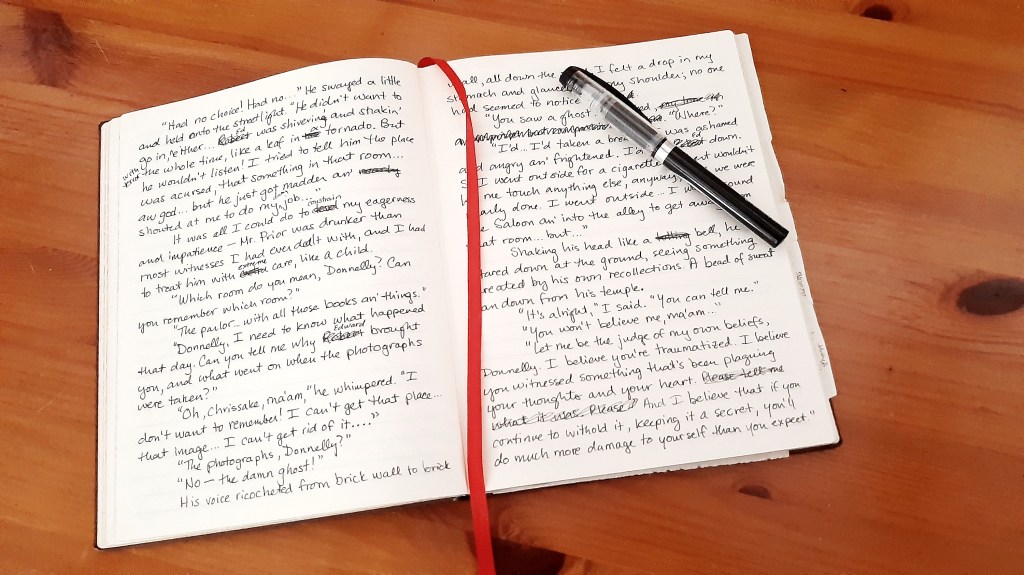
I had a desk. Jumbled on its dusty surface were stationery kits, candles, Lovecraft tomes, bejeweled boxes of trinkets, tarot cards, printed vision-board pictures of cottage gardens—the usual suspects. The problem was I never used the desk. My laptop never felt at home amid the items of my 19th-century obsession. But once the laptop was ditched in favor of an antique-looking lined journal and 3mm-tipped black pen, the vibes finally felt right.
When I lit my candelabra and opened my journal to the first page, I let myself drift into a mindset I’d not accessed in years: pure imagination. I had no goal, no deadline, or even a solid plot line. I knew I wanted to create a story, pulling it from the ether as I went and committing the words to the page without fear; but most of all, I wanted to have fun. Having fun while writing seemed so foreign to me and I wasn’t sure I’d be able to fully rid myself of the editor inside. But I had to try.
I started by thinking of my favorite things. The Victorian age. Mysteries. Ghosts. Esoteric secrets. History. Music. Old photographs. True crime. Strange characters. The cosmos.
From there, I built a simple idea: a woman who investigates spiritual phenomena arrives to an allegedly haunted inn, where a photographer has produced photos of strange entities. It’s the last quarter of the 1800s and the town of Ashwood holds many secrets.

That was it! That was what I had to work with. And as I wrote, my wrist and elbow aching within minutes, I found myself submerged in the vibes of this imagined world. Characters popped into the story of their volition. The photographer, I realized, was modeled after Lewis Carroll, one of my favorite historical figures. The inn’s proprietor, Mina Neptune, emerged as my witchy alter-ego.
Writing this story became irresistible. I thought about it day and night, and whenever I had free time, I’d plop down at my desk and scribble out a few more pages. After a while I didn’t even need the desk—I just hung out on the sofa while Tom gamed. I would squeal as I added some ghostly activity or a description of wet plate collodion developing methods and Tom would give me the side-eye.
The relief from extra screentime was also amazing. Every creative person will agree that technology, as wonderful as it is, can easily box-in the mind. The edges of the screen become scary wastelands full of orcs, where new ideas can’t possibly exist. As I mentioned in my post about going without the internet for six days, I noticed my ability to daydream and brainstorm was improving.
This lovely dance went on for months, on into 2022. By the time I moved to the island off Croatia in September, my novel was nearly finished.
It took a year to write a full-length novel by hand. Although I knew I’d have to type it up and edit—another huge task—the feeling of accomplishment was enormous. I’d completed projects and novels before, but this was different. This book was untouched by outside forces or expectations. It was fresh and full of my favorite things.
Is this how fanfic writers feel? I thought. When you put so much of your own passion, love, and nerdiness into something, what comes out is 100% authentic. This story was closer to my authentic self than anything else I’d written thus far in my career. And I wanted more.
There and back again
Going back to writing in Google Docs seemed like an impossible task now that I’d experienced the bliss of writing by hand. I didn’t want to leave Rivendell and journey into The Brown Lands again. And to be honest, joining forces with my editor-self sounded ominous—her hypercritical attitude hadn’t changed and she stood nearby, fully armed.
So I tried writing my massive historical novel by hand too. I hoped the spark of creativity would ignite for this story as it had for my paranormal mystery story, but somehow it didn’t work. The characters’ voices were inconsistent. The plot I’d laid out just wouldn’t move forward correctly. It was a mishmash of ideas and random scenes that didn’t really need to exist.
Understandably, I was bummed. How could I have such a vastly different experience? Had the novelty (pun intended) of the handwritten book worn out already?
Then it dawned on me. I couldn’t expect my chonk of a historical novel, with its 10 years of baggage, to feel freeing and limitless. It was already in progress, and the scope of the story was much larger: a shifting political landscape, poverty and wealth, classical music theory and society, secret police spies and murder plots . . . just HUGE. That meant it had to be constantly tamed for fear of it going off the rails.
What made my paranormal mystery story special was that was an intimate affair. The scope was small, there were only a handful of characters to keep track of, and it mainly took place at the haunted inn. When the protagonist did venture out, she had good reason and came back to the inn afterwards to report her findings. It was easy to contain.

I knew that if I wanted to have the handwritten experience again, I’d have to write something similar. Luckily I had tons of ideas for sequels to the story—like Sherlock, I’d follow the protagonist as she answers another call to investigate an alleged paranormal phenomenon.
It seems obvious, but the smaller the scope of a story, the easier (and more fun?) it will be to write by hand. The more details the brain has to keep track of, the less the neocortex can fantasize freely. It sounds counter-intuitive. Wouldn’t having a larger scope give you more possibilities for action? Doesn’t the limitation of a small setting keep you from doing wilder and more impressive things?
Not in my experience. Think of it like an open-world video game. Most of them, sorry to say, don’t have a great narrative story. Skyrim’s known for its incredible open world, but hardly anyone ever compliments its main storyline. Whereas narrative-heavy games that are more linear, such as The Last of Us, Detroit: Become Human, or Disco Elysium, are praised for their immersive story and characters. And that’s what novel writers should be going for.
The undying lands of creativity
The One Ring of Writer’s Block has been destroyed and creativity reigns supreme again. But I don’t want to leave you with just a story—I want you to be able to recreate it yourselves, so like a good food blogger would do, I’m going to give you a step-by-step recipe at the very end.
- Pick an inspiring journal that has plenty of pages. None of that back-to-school discount stuff at the grocery store. Go to a real bookstore, order off Etsy—make the effort to get something that you not only want to write in, but look at and carry with you.
- Do the same thing with your writing utensil of choice. Pencil, fountain pen, ballpoint, no matter what you choose, make sure you LOVE using it. And buy replacement cartridges. You’ll need them.
- Create a writing space that feels good. I suggest starting out with a desk, not a kitchen island or your bed. The more intent you put in the better. Eventually when the bug sets in, you’ll be able to write from anywhere. But start out in a special location that inspires you.
- Make a list of all your favorite things/topics. They don’t have to inform your story completely, but by allowing yourself to get all giddy and nerdy about your fave things, you’re opening up new avenues of creativity without extra effort.
- Choose only three things before writing: a setting, a protagonist, and the protagonist’s motivation. As I mentioned above, I had only a few ideas locked down before I started writing. The fly-by-the-seat-of-your-pants method is crucial to break down the walls of writer’s block. Later, you can spend more time on plot and characters; but not yet! Let your story flow moment to moment.
- Don’t schedule your writing. This might be harder depending on your time constraints, but try to let your inspiration guide you instead of Google Calendar. The more you associate your handwritten story with freedom and fun, the easier it will be to write.
- Stretch your hands and wrists regularly. One thing I didn’t do enough was care for my suddenly-overworked wrist tendons and knuckles. Hand yoga could help you avoid symptoms of carpal tunnel and the general soreness that comes from writing extensively by hand.
- Don’t, at any point, type up your story. Not even little sections. I confess that before I’d finished the story, I typed up one of the climactic scenes to see what it would look like. BAD MOVE. I started editing that sh*t. I started second-guessing things. I felt the spark fade little by little. When I went back to writing by hand, the process had already been tainted. Heed my warning and force yourself not to digitize at any point, not until the whole draft is done.
And that’s my recipe, friends! It may take you longer than a year, or much less if you’re writing a short story or even poetry, but no matter the timeline, let yourself be free.
Treat this project like a hobby, a piece of self-indulgent entertainment. Not a side-hustle, not an eventual bestseller. Stay light-hearted and giddy about it. Go down the rabbit-hole of your obsessions and favorite topics. Linger there awhile. Annoy your partner with sudden rants about Victorian photography, Liar’s Dice games, and demonology.
And when you’ve got two or three journals full of your incredible handwritten wordsmithery, you’ll long to do it all over again.
 Mar von Zellen
Leave a comment