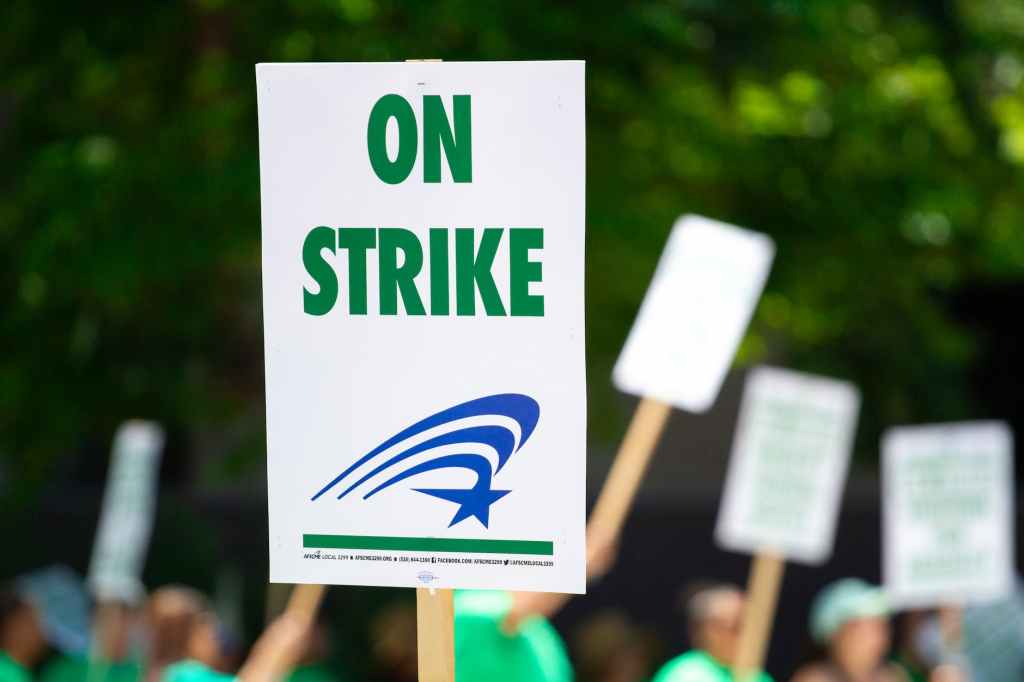

The WGA Writers’ Strike began on May 2nd of this year, and it’s brought up some issues that are personal to me. I always thought the world was my oyster, that I could do anything I set my mind to. I thought that with diligence I could reach my dream and be paid well for it. I thought respect came with the value of my art and content. But none of that syncs up with reality. The writers’ strike acts as a grim reminder of how hard it is to work a creative job—or ANY job—when there’s no support or protections, and just how unfairly CEOs continue to profit from our insecurity.
The WGA is a union formed to help screenwriters maintain a level of power in the TV industry—power that allows them to earn a living wage, receive fair contracts, and not be replaced by A.I. Some of things they’re fighting for are earnings that reflect inflation (their earnings have decreased by 23% since the last strike in 2007), contracts that last longer than a few days, a set number of writers on set and in writers’ rooms, fair residuals (according to personal accounts, some writers’ residual checks are now less than $2), and more. I highly recommend you watch Adam Conover’s podcast with two WGA negotiating commitee members to get the full picture:
One of the main antagonists of this writers’ strike is the innovation of streaming services. Production happens much differently now than when shows were created for cable, where viewers couldn’t binge a twelve-episode show over a weekend. With such a huge demand for fast content, streaming production CEOs make excuses about cutting costs wherever they can, raising their overall profits. For example, Netflix co-CEO Ted Sarandos raked in $50.3 million in 2022, an increase of 32% from the previous year.
But it’s not just streaming services and television production companies who are creating a vacuous, insecure job market—it’s spread across all industries. As a worker, I’ve come to realize there are certain things I need to be aware of if I don’t want to be crushed underfoot.
Your hard work could vanish. This is especially true for those who create art or writing for digital media. If both of the mobile apps I wrote for just disappeared off the App Store, so would my writing. I would have no way to show it off in its final form. All I can do is take screenshots. This “vanishing” effect can even happen during production—the quest dialogue you painstakingly crafted for a video game could be cut from the final version; a TV show scene that you alone wrote might be tossed or altered without your knowledge.
There’s so little we’re actually in control of when it comes to the longevity and availability of our work. How are we supposed to build a portfolio if things are scrapped, misplaced, or unplugged from the internet? I have almost everything on my Google Drive, but unless someone sees my writing inside the product or credited somewhere, I could be accused of bullshitting or plagerizing. It’s important that we demand proof of our work whenever possible and save it in permanent formats.
Getting credit is tricky. When I worked at Lipa, I wrote dozens of children’s stories and picture books and had to fight to get my name on them. Authors, one would assume, should be credited where their stories appear, whether in print or digitally. It shouldn’t matter that the author is writing under the umbrella of a corporation—they have created, almost singlehandedly, content that will make the company money. Voices of individual creators are silenced and disregarded in favor of the “department”, “team,” or “company”, and thus credit isn’t given where credit is due.
There are two scenarios I like to think of. The first is classical composers. In the 1700s, Joseph Haydn was under contract with a rich patron, Prince Nikolaus Esterhazy, who told him what music to write and when. All Haydn’s music technically belonged to Esterhazy. But guess what? It wasn’t Esterhazy’s name and coat-of-arms being printed on the music scores—it was Haydn’s. He was the creator of the art, the “product”.
The second scenario involves a modern-day artist like Taylor Swift. It would seem absolutely absurd to us if the label Big Machine Records paid Taylor for her lyrics and music and then never put her name or face on the finished albums. Instead, they would market the albums as their products, with their name, logo, and CEO cited in articles and social media posts. Taylor’s name would appear in the credits in small letters, maybe, or hidden in the lyrics and only dicipherable when a certain song is played backwards at half speed.
Having your name on something you created or helped to create shouldn’t be such a big deal, but it’s becoming consistently more difficult. Part of what the WGA are negotiating is due credit for ALL writers who worked on a project, not just the last one who handled a script. With the way streaming production is now, writers may be hired for a single day at a time, or they may work tirelessly for a couple weeks on a script only to see that their name never gets shown in the credits. If you work on something for any amount of time, you should be credited. So many writers have to jump from job to job, script to script, always uncertain whether their next gig will grant them anything worthwhile for a portfolio. It makes them, and fellow creatives, feel undervalued and expendable. Which brings me to my next point.
Security is a joke without unions. This goes for EVERYONE who works for a company. Graphics designers, writers, programmers, marketing agents, Amazon line workers, IT specialists—everyone suffers when CEOs view employees as cogs in a machine. Despite lots of progressive rhetoric going around on LinkedIn about how this-or-that company takes care of its people, it’s just not true in practice. With a goal of ever-increasing revenue, it can’t ever be true, because CEOs don’t really care about producing something meaningful; they’re beholden to shareholders and profit margins.
We’ve seen how, since the pandemic, companies have tripled their profits even when consumers have stopped buying as much stuff. The reason? Cutting costs. Using cheaper materials. Lobbying the government to dismantle regulations. Slashing long-term contract workers. Keeping salaries at the bare minimum. Hiring underage migrant laborers. Raising prices and blaming “inflation”. What we’re seeing most recently are giant layoffs—companies whose profits are stagnant can trick shareholders by firing hundreds of employees, which shows up as an increase in money on financial statements.
No one feels safe in their jobs. There’s little reason to be blindly loyal as a worker, which is why so many people “job hop”. We’re desperately trying to find secure footing in a fundamentally insecure situation. Even if we do stay at our jobs longer, current working conditions make it hard to feel valued. CEOs fire people instead of giving raises or changing bad practices; terrible planning results in exhausting crunch periods; leadership roles are given to employees who don’t necessarily have the skills or desire to lead, creating bad managers; company culture pushes employees to engage with each other as a “family” and put in extra time for free; and let’s not even TALK about “team-buildings”, the bane of our existence.
So, we could get fired at any time thanks to cutting costs, working conditions and company cultures suck (many are toxic, misogynistic, racist, etc.), and to top it off, wages are not rising as they should be. The average salary in Prague, for example, is still only around 43,000 crowns per month, or around $1,900, while rent for a one bedroom apartment in the city is about half that. Not to mention the monthly price for health insurance (VZP) and social security (CSSZ) has gone up every year by about twenty dollars. A week’s worth of groceries costs about $150 for two people, and if you have kids or pets . . . well, good luck! The EU, another type of beneficial union, can only do so much to keep its people afloat when the largest economy in the world, the US economy, is dragging everyone down with it.
Unions have been popping up more and more in response, trying to hold companies (read: CEOs) responsible for their actions. Even though Starbucks has continually used aggressive union-busting techniques like interrogations and illiegally firing union organizers, they’ve been hit with lawsuits covering 328 unfair labor practice charges. Unions allow workers to elect their own representatives who stand on a committee—and these reps are able to go directly to the shareholders themselves, pushing them to read and negotiate proposals. CEOs don’t want this, of course. They want to do whatever they like with whomever they like without repercussions. They want PROFIT.
“David Zaslav, the CEO of Warner Bros. Discovery, the parent company of the network I’m talking to you on right now [CNN], was paid $250 million last year, a quarter of a billion dollars. That’s about the same level as what 10,000 writers are asking him to pay all of us collectively, alright. So I would say if you’re being paid $250 million — these companies are making enormous amounts of money. Their profits are going up. It’s ridiculous for them to plead poverty.”
Adam Conover on CNN
The WGA has been bravely fighting against the Alliance of Motion Picture and Television Producers (AMPTP), who have rolled their eyes and shut down complaints thus far. But negotiations must begin soon—they’ll have no choice as shows and films 6 months down the line will have no scripts. And with solidarity being shown by thousands of non-writer crew members, actors, and everyday people who just want to see everyone retain their rights, I think this strike is happening at exactly the right moment.
Remember: without unions, we wouldn’t have the 40-hour work week with overtime pay. WE WOULDN’T HAVE WEEKENDS! Unions played a major role in ending sweatshops and child labor (which is making a return without them). Unions have helped get workers essential protection from workplace hazzards, including safety uniforms and compensation for on-site injuries. Unions carry out important deeds on a smaller scale, too: union letter carriers save lives by alerting officials when they notice an elderly person hasn’t collected their mail; union workers made sure 700 kids in Erie, Pennsylvania got back-to-school haircuts; union firefighters raised funds for breast cancer research by wearing and then selling their “Fighting for a Cure” t-shirts.
It truly is simple: as a worker, I want respect. I want my art to be valued. I want to be valued as a creator. I don’t want to fight so hard to stay afloat. But in this tumultuous period of late-stage capitalism, when average people are suffering at the hands of a couple dozen billionaires, the only way to stand up for yourself and for each other is through unification. It’s not easy. Companies will do whatever they can to break up union-forming attempts. But we have to try.
Personally, I’d love for the video game industry to start unionizing. There’s not a single union that I know of to protect people in an industry that has been run for so long by middle- and upper-class white males. Now that things are changing, large studios stuck in their toxic ways actively hurt and silence employees instead of trying to change—resulting in horrible situations like the sexual harrassment at Activision Blizzard that had been going on for years. CEOs and companies need to face the music—we can communicate faster and better than ever with the internet, we have more compassion for each other, and we know what they’re up to. They can’t hide from us any longer.
Whether you’re a creative worker, a line worker, an essential worker, or anything in between, it’s important to look out for yourself and your colleagues. CEOs are profiting from our insecurity—and that money ain’t trickling down, friends. Stay informed about strikes and unionizing efforts near you and learn how you can get involved.
 Mar von Zellen
Leave a comment